Σάββατο 16 Ιουλίου 2011


Μέγας Αλέξανδρος: Η εκστρατεία που άλλαξε τον κόσμο
 Image via WikipediaΗ εκστρατεία που άλλαξε τον κόσμο ντοκιμαντέρ ΕΡΤ3 2009 Η σειρά εμπεριέχει αποσπάσματα από παραγωγές της ΕΡΤ3 χρονικής περιόδου 1995-2008. Στους 25 αιώνες, που έχουν περάσει από την εποχή του Αλεξάνδρου, έχουν γραφεί γι' αυτόν πολλά και έχουν εξετασθεί πτυχές της ζωής και της δράσης του. Η νέα σειρά βλέπει τα γεγονότα από μια άλλη σκοπιά. Διασταυρώνει τα ιστορικά στοιχεία, τα αντιπαραθέτει και αποκαλύπτει όλες τις άγνωστες πτυχές της στρατιωτικής ιδιοφυΐας του Μεγάλου Αλεξάνδρου, του χαρακτήρα του ανθρώπου που ξεπέρασε τον εαυτό του και δημιούργησε την πρώτη μεγάλη αυτοκρατορία στην ιστορία. Γεγονότα, πρόσωπα, στρατηγοί και απλοί στρατιώτες, ίντριγκες και φιλοδοξίες., ανατροπές και επιτεύγματα, δολιοφθορές και μύθοι που θα μας συναρπάσουν! Σενάριο-Σκηνοθεσία: Νίκος Βεζυργιάννης Αφήγηση: Χρήστος Ατζημάκης
Βιβλίο: Πρόκλου Περι αιωνιότητας του Κόσμου
 Image via Wikipedia
On the eternity of the world
By Proclus, Helen S. Lang, Anthony David Macro, Jon McGinnisUniversity of California Press, 2001 - Science - 189 pages
Proclus's eighteen Arguments were quoted within John Philoponus' polemic against him, written in the sixth century; but the opening pages of the sole extant manuscript, which contained the first Argument, have been lost. In this book, Helen Lang and A.D. Macro present the seventeen Arguments preserved by Philoponus and translate them as an independent work. The first Argument, which survives in Arabic, is also included and makes this the only complete edition of On the Eternity of the World since antiquity.
This bilingual edition comprises the seventeen Arguments (II-XVIII) in Greek and English, along with an introduction, synopses, and detailed notes which help readers with or without Greek to understand them philosophically and historically. Two appendices complete the volume: the Arabic text of the first Argument, also with English translation and notes, and the first modern edition of an important Latin translation from the Renaissance.
In a valuable introduction, Lang and Macro examine the complex history of these Arguments. Together with its excellent annotations, and English and Greek texts en face, the publication of Proclus's On the Eternity of the Worldmakes available an influential work by a major figure in the history of late Greek philosophy.
In the fifth century A.D., Proclus served as head of the Academy in Athens that had been founded 900 years earlier by Plato. Proclus was the last great systematizer of Greek philosophy, and his work exerted a powerful influence in late antiquity, in the Arab world, and in the Renaissance. His treatise On the Eternity of the World formed the basis for virtually all later arguments for the eternity of the world and for the existence of God; consequently, it lies at the heart of neoplatonic philosophy and the controversy between pagans and Christians at the end of antiquity.
Proclus's eighteen Arguments were quoted within John Philoponus' polemic against him, written in the sixth century; but the opening pages of the sole extant manuscript, which contained the first Argument, have been lost. In this book, Helen Lang and A.D. Macro present the seventeen Arguments preserved by Philoponus and translate them as an independent work. The first Argument, which survives in Arabic, is also included and makes this the only complete edition of On the Eternity of the World since antiquity.
This bilingual edition comprises the seventeen Arguments (II-XVIII) in Greek and English, along with an introduction, synopses, and detailed notes which help readers with or without Greek to understand them philosophically and historically. Two appendices complete the volume: the Arabic text of the first Argument, also with English translation and notes, and the first modern edition of an important Latin translation from the Renaissance.
In a valuable introduction, Lang and Macro examine the complex history of these Arguments. Together with its excellent annotations, and English and Greek texts en face, the publication of Proclus's On the Eternity of the Worldmakes available an influential work by a major figure in the history of late Greek philosophy.

Τετάρτη 13 Ιουλίου 2011
Greeks and Jews in BCE antiquity, a reply to C. Plevris.

by G. Sidirountios
"Keep this in mind: The Jews are the chronic enemies of the Greeks." This is the opening sentence in the book Jews: The Whole Truth (Athens, 2006), written by Constantine Plevris. The question here is, what is the body of historical evidence examined, to argue that Jews and Greeks were perpetual enemies? The following examination of ancient sources does reveal a very different picture.
In the Hebrew Genesis, one of the grandsons of Noah is called "Javan." The ancient Greek Septuagint version of the Old Testament, has this name translated as "Ionas" [1]. This name is no other than the singular of "Ionians," one of the main ancient Greek tribes, all of which claimed ancestry from Titan Prometheus. It is evident that the Old Testament, by naming Noah as the ancestor of Jews and Ionians, presents a theory of common descent for both ancient peoples. Similarly to the Old Testament, there are other ancient sources which also present theories that different ancient peoples did have common ancestry. Such theories, regardless if they are historically accurate or not, do reflect the fact that the further back we go in history, the more chances we all have to find common descent.
In another Old Testament passage, in Joel, there is a report that some residents of the ancient cities Tyre and Sidon captured certain Jews and then sold them as slaves to the "Jevanim." This is the plural of Javan - Ionas we have seen above. Clearly, "Jevanim" refers to no others than Ionians. However, in the ancient Greek Joel this was translated as "Greeks," simply because the Jevanim were of a Greek descent. In a certain passage in Greek Ezekiel, "Javan" was translated as "Greece," a country which traded slaves and copper utensils. Another instance in Ezekiel refers to some people from the Greek island of Rhodes who traded ivory with some Jews [2]. Up to this moment, we have seen no indication of any bias or hatred between Jews and Greeks. Until the arrival of Alexander the Great in the lands of Israel, there is no historical evidence about any conflict between Jews and Greeks, unless one considers the Philistines as being of Greek descent. So far, scientific research did not come to safe conclusions on the origin of the language the ancient Philistines spoke. Most historical indications, also supported by archaeology, are that the culture of the Philistines was Semitic.
With the arrival of Alexander the Great in Israel, there is evidence of cooperation between Greeks and Jews, but also that Alexander's army invaded and destroyed Samaria [3]. Here it makes no sense to blame the Samaritans for being attacked, for is it not possible they provoked the foreign army to come and invade their land. What is clear is that, from the very beginning of their arrival, Alexander's Greeks did make an alliance with some Israelites, the Jews, while the same time they had a conflict with some other Israelites, the Samaritans. This is also confirmed by a reference in Mishnah Yoma 69a, where a certain Israelite High Priest called Simon the Just, punished the Samaritans by the approval of Alexander. Therefore, it makes sense that Greek forces did side together with the Jewish Israelites against the Samaritan Israelites.
After the death of Alexander the Great, his kingdom was divided into smaller kingdoms by his generals. Many Israelites were unfortunate to live in lands which constituted the disputed borders between the two newly formed Greek kingdoms of the Ptolemies and the Seleucids. Here we should ask Mr Plevris if he knows how many times troops crossed the lands of the Israelites within the first twenty years of those Greek civil wars [4], and who had to serve the needs of those armies in water, food, heating and sex, if not the local civilians? At the beginning of one of those wars, some Jews in Jerusalem stood by the side of the Greek King Seleucos Nicator. But he lost the war, and the fate of Jerusalem was to be razed to the ground by the winner Greek King Ptolemy Soter [5]. Clearly, the rivalry between the Greek kingdoms resulted to divisions among the Israelites themselves. Some of them agreed to serve in the armies of the Ptolemies, while others sided with the Seleucids. After all, they lived in between those two kingdoms, and the borders were disputed and changing. People were forced by the circumstances to take sides, as a matter of survival. There is evidence that each Greek kingdom treated their own Jewish allies as equal, and rewarded them for their services [6]. In essence, both the Greeks and the Jews, but also other ethnic groups, were divided. Mixed Judeo-Hellenic troops were often involved in civil wars, centred around the interests of "royal" individuals. For example, in about 201 BCE the Seleucids began new wars against the Ptolemies in order to annex areas which included Judea. Some Jews in Jerusalem who were openly on the side of the Seleucids, revolted against the Ptolemies, who up to that time controlled Jerusalem. As a result the city changed camp, and became part of the Antiochean kingdom of the Seleucids [7]. The same time there are reports that king Ptolemy Philopator the fourth made reprisals against some Jews living in Egypt, for he had just lost Jerusalem, and most probably he regarded some of his former Jewish allies with much suspicion. However, the same reports indicate that the Greek people of Egypt did not support their King's policy to persecute the Jews, and protected them from the King's authorities. Philopator was forced by the circumstances to recall his menace and leave the Jews in peace [8].
In the BCE world, relations between Jews and Greeks were not uniformed, monolithic, black or white. The above, but also further evidence deriving from ancient sources, indicates that Greeks and others often were allies to the Jews, and not permanent enemies, as Plevris proclaimed. One of the most known examples of solidarity towards the Jews is that of the Queen Helen of Adiabene who embraced Judaism, and in the middle of the first century CE saved the people of Jerusalem from starvation [9]. Relations between Greek and Jewish leaders were often brotherly, such as those between King Antiochus Seleucus the third and High Priest Onias the third [10]. However, there is a general tendency to pay particular attention to the disastrous events which took place during the reign of a single Greek king, Antiochus the fourth, the so called Epiphanes (c. 215 - 164 BCE). Many scholars and others, judge the entire ancient Jewish - Greek relations from some events which took place just during the reign of Epiphanes. But even those particular events, have not been properly analysed by those who refer to them in order to prove that Jews and Greeks were enemies.
Although it is impossible to cover the subject in depth within these few pages, I should state here that even during the reign of Epiphanes, things were not absolutely back and white between Greeks and Jews. After the death of Antiochus the third, Jason the "brother" of High Priest Onias the third, made a personal alliance with the new Greek king Epiphanes and deposed his own brother Onias to take the Jerusalem Throne for himself. Those days, the Kings promoted their own personal friends and colleagues to the administration of their kingdom. In a similar way, modern leaders soon after they gain power, also promote their own people within their own new governments. High Priest Jason was in fact an important member of the new government of Antioch. He was the first Jewish leader who tried to put Jerusalem in the world map as a proper city - state. Until Jason's days, Jerusalem did not have the relevant organisation and foundations to be recognized as a city - state. It did not have an organised political structure according to the international Hellenic requirements of the times. Also, it had no theatre, no stadium, no regulated market to the international Hellenic standards of the time, and it did not have recognised educational foundations. But Jason's decisiveness and abilities were strong enough to succeed in fulfilling many important criteria, and as a result the Hellenic authorities recognised Jerusalem as a proper city-state. All those changes in the economy and the organisation of Jerusalem, introduced by Jason, must have brought prosperity to his people. Regardless Jason's immense success in elevating the status of his country, some conservative elements of the Jewish society accused Jason as an importer of foreign customs and immorality to Israel [11]. However, the opposition of some hard - line elements did not make any serious challenge to Jason's authority. The serious problems for Jason came from the same man who lifted him to the High priest throne, king Epiphanes, who himself was in a dire strategic position. He had to find revenue in order to finance large scale wars in two different fronts; against the Persians in the East and against the Ptolemies in the West. Being short of revenue, one of the measures he took was auctioning the office of the High Priest to the highest bidder. In other words, he demanded that Jason should increase the taxation of the Jews in order to help financing the wars. If Jason could find the money required, he could keep his office. If not, whoever had the money, could buy the office for himself. We see the same tradition of auctioning offices also in the Ottoman Empire, when the richest Christian Bishop could buy from the Sultan the office of Patriarch, thus becoming leader of the Christian Church just because he had the money. The Greek King Epiphanes eventually sold the High Priest office to the highest bidder, the 'brother' of Jason, Menelaus [12]. Jason did not accept his fate to lose; he left Jerusalem, and presented himself as an ally to the enemy of Epiphanes, the Greek King Ptolemy the sixth, hoping that if the Ptolemies win the war, there was a chance for him to return to his position. At a later stage Jason also sided with the Spartan Greeks. Some time before, his nephew Onias the fourth together with some followers, had left Jerusalem and settled in Heliopolis of Egypt, under the sponsorship of the Greek King. There they built the third Temple of the Israelites. The first was in Jerusalem and the second in the mount of the Gerizim [13]. From the above evidence and from further historical developments to be examined, it is obvious that mixed Judeo-Hellenic alliances did exist. This is a political pattern which persisted throughout the BCE era, from Alexander onwards. Also, it is clear that neither the Greeks, nor the Jews were united as two monolithic ethnic or religious or political groups.
When Epiphanes was fighting at the front against the Ptolemies, a faction of Jews revolted against his authority and tried to seize control of Jerusalem, but they failed. This of course angered the king, who as soon as he returned from the front, in addition to the punishment of his Israelite opponents, he confiscated the treasures of the Jerusalem Temple with the help of the faction led by High Priest Menelaus [14]. Apparently, this was an act aiming to cover the financial needs of his wars. The precious metals of the offerings in the Temple could be easily melted in order to produce coins. This is how the soldiers were paid; with coins. Unpaid and unhappy soldiers do have a record in the ancient times of overthrowing their leadership. The confiscation of the property of various temples was a practise repeated by a number of Kings throughout the centuries, in order to pay for their financial needs. Ancient Temples were often not just religious centres, but they had treasuries and acted like banks. Constantine the Great in the fourth century CE became famous for confiscating the property of a large number of ancient Greek temples, in order to decorate his famous city, Constantinople. This of course horrified the Greeks, for they witnessed their holy places being stripped from the most valuable objects, accumulated and created by their ancestors for centuries. Several centuries later, the people of Constantinople were themselves horrified to witness the looting of their most Holy Temple of Agia Sophia by the merchants of Venice in 1204. This is exactly how the Jews must have felt, seeing the King confiscating their own treasures of their own most Holy Temple. Although High Priest Menelaus and his followers remained on the side of Epiphanes, some other Jews reacted against the king's theft, and rebelled. The fourth book of the Maccabees, which many scholars regard as a fictitious novel, tells us that one of the measures taken by Epiphanes against the rebels, was to force them to abandon their religion. However, those Jews who supported Epiphanes continued to maintain their priestly positions and they functioned within the Temple, meaning that even during the times of troubles, there was continuity in worshiping the One God. Menelaus the High Priest, together with the priests and his Jewish faction, remained on the side of the king throughout the crisis. There is no evidence that those who were on the side of Epiphanes were forced to change their religion. What is clear is that those who opposed Epiphanes did face persecution. It is of particular interest for the Christian world that St. Gregory of Nazianzus (c. 329-c. 390) named some of those who were exterminated by Epiphanes as the first martyrs of the "True Faith," meaning Christianity. The memory of those martyrs is still celebrated by the Orthodox Church every first day of August [15]. In other words, Christianity finds some of its roots deep into the movement against Epiphanes, about 200 years before Jesus preached.
The infamous Epiphanes lost his life in a battle against the Persians. The new Greek King who succeeded him, Antiochus Eupator, murdered High Priest Menelaus, and gave the office to his Jewish friend Alcimus [16]. This clearly means that the new Greek King opposed the political party of Menelaus, and became an ally of another Jewish party which supported Alcimus. The second book of the Maccabees reveals that Eupator, by personal orders, restored the situation in the Temple of Jerusalem as it was before Epiphanes [17]. Later, Eupator was murdered by his cousin Demetrios Seleucos (r. 162-150 BCE) who became the new Greek King of Antioch and a new ally to High Priest Alcimus. This pattern of mixed alliances between certain Greeks and certain Jews continues up to the first century BCE, when the Romans became the new rulers of the area. For example, the Greek King Demetrios at some stage co-operated with Judas Maccabee [18]. Later Judas confronted Demetrios and this is how he lost his life [19]. The brother of Judas Maccabee, Jonathan, was an ally to the Greek usurper - King Alexander Balas, who had murdered Demetrios to take the throne for himself. Balas appointed his own Jewish friend and ally Jonathan, the brother of Judas Maccabee, as a new High Priest [20]. In other words, a new mixed Judeo-Hellenic party gained control of the area. When at some stage a Greek leader called Tryphon, made war against Balas in order to become King himself, Jonathan with his Jewish troops run in support to the party of Balas, and this is how Jonathan lost his life [21].
There is more historical evidence which reveals that Greeks and Jews were not united in BCE antiquity as two different peoples, but they often formed mixed Judeo-Hellenic alliances, centred around the interests of individual leaders. Our modern mode of thinking applies modern perceptions about nation - states with fixed borders. In antiquity the Eastern Mediterranean world was much different. The examination of few more ancient incidents which followed the times of Jonathan, may help us further to understand how mixed the ancient Judeo - Hellenic world was. For example, the Greeks of Egypt supported the brother of High Priest Jonathan, Simon, to raise expansionist wars against the Greek Kingdom of Antioch. The same time the Jewish High Priest Alcimus maintained his own alliance with a certain Greek leader called Bacchides, who in turn managed to exterminate Simon and reinstate Alcimus at the High Priest throne of Jerusalem [22]. In other words, the mixed Judeo-Hellenic party of Alcimus and Bacchides won over the mixed Judeo-Hellenic party of Simon and the Ptolemies. Similarly, the son of Simon, Hyrcanus (134-104, BCE), raised war both against some Greeks and some Israelites [23], while the Greek Ptolemy Lathouros together with some Israelites fought against Hyrcanus [24]. The son of Hyrkanos, Aristoboulus, being a proper Jew, he also became known as philhellene because of his friendship with Greeks [25]. The son of Aristoboulus, King Alexander Jannaeus (103-76 BCE) had Greek troops on his side during battles against the Greek king Demetrios Philopator, while Demetrios was also supported by some Jewish troops [26]. One should also note that the eight hundred Pharisees crucified by Alexander Jannaeus were allies of the Greek King Dimitrios Philopator [28]. So, who was friend and who was enemy of whom those times? Clearly, the conflicts were centred mainly around the political interests of leaders, and not around cultural or religious differences. The basic argument of this article is that we cannot find evidence to support Mr Plevris, simply because neither the Jews nor the Greeks were united against each other. We have seen that Jews and Greeks often formed mixed Judeo-Hellenic alliances which were involved into what in essence were civil wars. There is much evidence surviving to indicate that, apart from political and military alliances or conflicts between certain Jews and certain Greeks, there had also been much cultural exchange. A number of Greek Kings donated to the Temple of Jerusalem more than what Epiphanes confiscated. In turn, the famous King of the Jews Herod the Great was admired by Greeks for having built gymnasiums, theatres, markets and even pagan temples. He was also a sponsor of the Olympic Games [29]. Archaeology often comes to contradict and overthrow stereotypes, such as that the Jews did not have images inside their own synagogues. The truth is that they did decorate the interiors of some Synagogues even with scenes from ancient Greek mythology. Plenty of evidence survives that Greeks did go to Synagogues to pray together with the Jews and some of them became Jewish, while Jews did go to pray to Greek Temples and some of them became pagan. There is little doubt that the ancient BCE world was something very different from what many of us have previously thought.
In overall, the conclusion made by Plevris that Jews and Greeks were perpetual enemies is proved superficial, because it does not derive from the analysis of the available body of evidence.
Please feel free to distribute or publish this article anywhere.
February 2011
George Sidirountios
gsiderountios@gmail.com
Notes
[ 1 ] Ιωυαν: Γένεσις, 10:2-6, ed. A. Rahlfs, Septuaginta, 2 vols (Stuttgart, 1935).
[ 2 ] Ιωήλ, 4:4-6, Sept. ed. cit., v. 2, pp. 519-524 :... καὶ τοὺς υἱοὺς Ιουδα καὶ τοὺς υἱοὺς Ιερουσαλημ ἀπέδοσθε τοῖς υἱοῖς τῶν Ἑλλήνων,...; Joel, 3:4, trans. of the Hebrew text into English : The Jewish Publication Society of America, The Holy Scriptures according to the Masoretic text, a new translation (Philadephia, 1917), p. 724; Ιεζεκιήλ, Sept. ed. cit., 27:13,. v. 2, p. 818: ἡ Ἑλλὰς. Cf. The Holy Scriptures, p. 677. Ροδίτες: Ιεζεκιήλ, 7:15.
[ 3 ] Flavius Josephus, Antiquitates Judaicae, 11, 317-347, ed. B. Niese, Flavii Iosephi opera, 6 vols. (Berlin,1885-1894), v. 3, p. 64-70. Historia Alexandri Magni, Recensio 3, par. 24, ed. H. Engelmann, Der griechische Alexanderroman, Rezension G., 3 vols (Meisenheim am Glan, 1963), v. 2, p. 216. Quintus Curtius Rufus, trans. J. Rolfe, Quintus Curtius, History of Alexander, 2 vols. (Loeb: London, 1936), 4.8-11, pp. 239-241. Jos., Ant. 11.345, v. 3, p. 70.
[ 4 ] M. Hengel, Judaism and Hellenism (London, 1981), trans. J. Bowden from Judentum und Hellenismus, Studien zu ihrer Begengung unter besonderer Berücksichtigung Palästinas bis zur Mitte des 2 Jh.s v. Chr. (Tübingen, 1973), pp. 12-18.
[ 5 ] Apian, Syriaca, 252, ed. P. Viereck, A.G. Roos and E. Gabba, Apiani historia Romana (Leipzig, 1967), p. 398. Josephus, Contra Apionem, 1. 208-212, ed. Niese, v. 5, p. 37-38. Jos., Ant., 12, 5-10, v. 3, pp. 73-74.
[ 6 ] Jos. Ant., 12.119, v. 3, pp. 92-93: Ἔτυχον δὲ καὶ τῆς παρὰ τῶν βασιλέων τῆς Ἀσίας τιμῆς, ἐπειδὴ συνεστράτευσαν αὐτοῖς; Idem, Contra Apionem, 2. 42-47, v. 5, pp. 59-60.
[ 7 ] Jos. Ant., 12.129-146, v. 3, pp. 94-97.
[ 8 ] 3 Macc., 3.8: οἱ δὲ κατὰ τὴν πόλιν Ἕλληνες οὐδὲν ἠδικημένοι ταραχὴν ἀπροσδόκητον περὶ τοὺς ἀνθρώπους θεωροῦντες καὶ συνδρομὰς ἀπροσκόπους γινομένας βοηθεῖν μὲν οὐκ ἔσθενον, τυραννικὴ γὰρ ἦν ἡ διάθεσις, παρεκάλουν δὲ καὶ δυσφόρως εἶχον καὶ μεταπεσεῖσθαι ταῦτα ὑπελάμβανον· μὴ γὰρ οὕτω παροραθήσεσθαι τηλικοῦτο σύστεμα μηδὲν ἠγνοηκός. ἤδη δὲ καί τινες γείτονές τε καὶ φίλοι καὶ συμπραγματευόμενοι μυστικῶς τινας ἐπισπώμενοι πίστεις ἐδίδουν συνασπιεῖν καὶ πᾶν ἐκτενὲς προσοίσεσθαι πρὸς ἀντίληψιν.
[ 9 ] Jos. Ant., 20.17-53.
[ 10 ] 2 Macc., 3-4, v. 1, pp. 1104-1110.
[ 11 ] 1 Macc., 1.15, v. 1, p. 1040.
[ 12 ] 2 Macc., 4. 23-24. v. 1, p. 1108.
[ 13 ] 2 Macc., 5.5-10, v. 1, pp. 1110-1111; Ant., 12. 387. v. 3, p. 139.
[ 14 ] 2 Macc., 5.15-16, v. 1, p. 1111.
[ 15 ] Εἰς τοὺς Μακκαβαίους, MPG, v. 35, col. 912-933.
[ 16 ] 2 Macc.,14. 1-13, v. 1, pp. 1133-1134.
[ 17 ] 2 Macc., 11.22-26, v. 1, pp. 1127. The authenticity of the document contained in this part of the 2 Maccabees is disputed by some scholars: "... ἀλλὰ τὴν ἑαυτῶν ἀγωγὴν αἱρετίζοντας ἀξιοῦντας συγχωρηθῆναι αὐτοῖς τὰ νόμιμα, αἱρούμενοι οὖν καὶ τοῦτο τὸ ἔθνος ἐκτὸς ταραχῆς εἶναι κρίνομεν τό τε ἱερὸν ἀποκατασταθῆναι αὐτοῖς καὶ πολιτεύεσθαι κατὰ τὰ ἐπὶ τῶν προγόνων αὐτῶν ἔθη."
[ 18 ] 2 Macc., 14.6, v. 1, p. 1134.
[ 19 ] 1 Macc., 9, v. 1, pp. 1069-1073.
[ 20 ] 1 Macc., 10. 15-21, v. 1, p. 1074.
[ 21 ] 1 Macc. 1, 9.31-13.26, v. 1, pp. 1070-1089.
[ 22 ] Jos. Ant., 12.413, v. 3, p. 144.
[ 23 ] Jos. Ant.., 13.280-281, v. 3, p. 203.
[ 24 ] Jos. Ant., 13.278-279, v. 3 p. 203.
[ 25 ] Jos. Ant., 13.280-281, v. 3, p. 203.
[ 26 ] Jos. De Bello, 1.93-95: Δημήτριος μὲν τοὺς Ἀλεξάνδρου μισθοφόρους, Ἀλέξανδρος δὲ τοὺς ἅμα Δημητρίῳ Ἰουδαίους μεταπείσειν ἐλπίσας. ὡς δ' οὔτε Ἰουδαῖοι θυμῶν οὔτε οἱ Ἕλληνες ἐπαύσαντο πίστεως, διεκρίνοντο ἤδη τοῖς ὅπλοις συμπεσόντες.
[ 27 ] Jos. Ant., 13. 372-376, v. 3, pp. 220-221.
[ 28 ] Jos. Ant., 13. 328-357. Contra Apionem, 2.48-58, v. 5, p. 60 ff.
[ 29 ] Jos. De Bello, 1.403-428, v. 6, pp. 92-98; Jos. Ant., 15.329-330, v. 3, p. 391.
Οι ανθρωποθυσίες της Παλαιάς Διαθήκης εκτός της του Αβραάμ
 Image via Wikipedia
Και έκαμεν ο Μωϋσής και Ελεάζαρ ο ιερεύς καθώς προσέταξε Κύριος εις τον Μωϋσήν.
Και τα λάφυρα τα εναπολειφθέντα εκ της λεηλασίας, την οποίαν έκαμον οι άνδρες οι πολεμισταί, ήσαν πρόβατα εξακόσια, εβδομήκοντα πέντε χιλιάδες,
και βόες εβδομήκοντα δύο χιλιάδες,
και όνοι χιλιάδες εξήκοντα μία,
και ψυχαί ανθρώπων, από των γυναικών αίτινες δεν εγνώρισαν κοίτην ανδρός, πάσαι αι ψυχαί, τριάκοντα δύο χιλιάδες.
Και το ήμισυ, το μερίδιον των εξελθόντων εις τον πόλεμον, ήτο κατά τον αριθμόν, τα πρόβατα τριακόσια τριάκοντα επτά χιλιάδες και πεντακόσια·
και το απόδομα του Κυρίου από των προβάτων ήτο εξακόσια εβδομήκοντα πέντε·
και οι βόες τριάκοντα εξ χιλιάδες, και το απόδομα του Κυρίου εβδομήκοντα δύο·
και οι όνοι τριάκοντα χιλιάδες και πεντακόσιοι, και το απόδομα του Κυρίου εις και εξήκοντα·
και ψυχαί ανθρώπων ήσαν δεκαέξ χιλιάδες, και το απόδομα του Κυρίου τριάκοντα δύο ψυχαί.
(Αριθμοί 31:31-40)
Οι ανθρωποθυσίες στην εβραϊκή παράδοση είναι κοινή θεϊκή και πατριαρχική παράδοση. Ο θεός τους θέλει να ελέγχει όχι μόνο τις πράξεις τους αλλά και τις σκέψεις τους. Η πολύ γνωστή θυσία του Αβραάμ, έχει με τελετουργικό σκοπό να ελέγξει τις ενδόμυχες σκέψεις των εβραίων και να τους κάνει να πιστέψουν ότι ο θεός τους ακούει τις σκέψεις και τις προθέσεις τους.
Αλλά στο παραπάνω εδάφιο βλέπουμε ότι όχι μόνο η προσωπική σκέψη υπέρ του συγγενή αλλά και η διάθεση προς τον αιχμάλωτο εχθρό φτάνει την αγριότητα των ζώων.
Δε τους έφτασε
- η επίθεση σε ξένες χώρες που τις θέλανε για δικές τους
- η νίκη επί των εντόπιων κατοίκων
- οι θάνατοι χιλιάδων αντιπάλων
- η αιχμαλωσία χιλιάδων άμαχων γυναικόπαιδων
- η αιχμαλωσία χιλιάδων στρατευμένων αμυνομένων
- η κατάσχεση ως λάφυρα χιλιάδων ζώων
- η προσφορά των κλεμένων στο ιερό για εξιλέωση των ψυχών των Εβραίων μαχητών
- η σφαγή προς κατανάλωση των ιερέων τους μερικών εκατοντάδων ζώων
αλλά ήθελαν και να προσφέρουν στο θεό τους ως θυσία 32 ψυχές αιχμαλώτων. Και μη φανταστεί κανένας ότι εννοούσαν δουλία των αλλόφυλων στο ναό τους, αλλά μιλάμε για προσφορά αίματος ως θυσία στο πανάγαθο Γιαχβέ πατέρα του Γεσούα.

Η ΓΛΩΣΣΑ ΤΩΝ ΑΡΧΑΙΩΝ ΜΑΚΕΔΟΝΩΝ
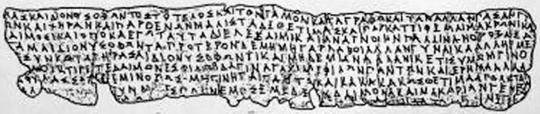
Αρχαία μακεδονική επιγραφή
.
.
Του Ιωάννη Μ. Ακαμάτη
Το πρώιμο νεκροταφείο της Αγοράς της Πέλλας μας έδωσε τα πιο σημαντικά ευρήματα. Από το τέλος του 5ου αι. π.Χ. προέρχεται η επιτύμβια στήλη του Ξάνθου. Ενός φτωχού σχετικά παιδιού. Για να γίνει η μικρή στήλη ξαναχρησιμοποιήθηκε ένα κομμάτι μάρμαρο. Η επιγραφή στη στήλη γράφει: ΞΑΝΘΟΣ/ΔΗΜΗΤΡΙΟ/Υ ΚΑΙ ΑΜΑ/ΔΙΚΑΣ ΥΙΟΣ.
2. Η συνίζηση του α και ο γίνεται α όχι ω, πχ. Ταν άλλαν πασάν αντί των άλλων πασών, χηράν αντί χηρών κ.λ.π.
3. Γενικά και άλλες ιδιαιετερότητες μας βοηθούν να κατατάξουμε την γλώσσα του κειμένου στην ομάδα των ΒΔ δωρικών ελληνικών βέβαια διαλέκτων. Αυτή λοιπόν είναι η Μακεδονική και αυτή εννοείται όταν ο Αλέξανδρος μιλά στους στρατιώτες του Μακεδονιστί.
Η Πέλλα, η πρωτεύουσα του Φιλίππου και του Αλεξάνδρου και των διαδόχων τους αποκαλύπτει σταδιακά τα μυστικά της και καθημερινά επιβεβαιώνει την πεποίθηση του Ξενοφώντος που την αναφέρει ως την μεγίστην των εν Μακεδονία πόλεων. Η πόλη έγινε η πρωτεύουσα της μεγαλύτερης κοσμοκρατορίας που είχε γνωρίσει ο κόσμος ως τότε.
.
.
Η γλώσσα των αρχαίων Μακεδόνων
(νέα στοιχεία από την Πέλλα).
Του Ιωάννη Μ. Ακαμάτη
.
 Image via Wikipedia Για μεγάλο χρονικό διάστημα η γλώσσα που μιλούσε ο λαός των Μακεδόνων υπήρξε αντικείμενο συζητήσεων και διαφορετικών προσεγγίσεων. Από μερικούς μάλιστα ερευνητές, τον αμερικανό καθηγητή BORZA και τους μαθητές του, θεωρήθηκε πως το σύνολο των ελληνικών επιγραφών που βρέθηκε στη μεγάλη Τούμπα της Βεργίνας ανήκουν στους συγγενείς των βασιλέων, αφού οι τάφοι είναι βασιλικοί. Η γλώσσα τους λένε είναι φυσικό να είναι η ελληνική αφού οι ίδιοι μελετητές υποστηρίζουν πως η βασιλική οικογένεια και η ανώτατη τάξη μόνο είχαν εξελληνιστεί. Είναι όμως έτσι τα πράγματα;...
Είναι προφανές πως το επιχείρημα αυτό θα κατέπιπτε αν είχαμε ελληνικά κείμενα που ανήκουν στους κοινούς ανθρώπους και χρονολογούνται πριν από τα χρόνια του Μεγάλου Αλεξάνδρου και της κοινής ελληνικής, ας πούμε πριν από τα μέσα του 4ου αι. π.Χ. Image via Wikipedia Για μεγάλο χρονικό διάστημα η γλώσσα που μιλούσε ο λαός των Μακεδόνων υπήρξε αντικείμενο συζητήσεων και διαφορετικών προσεγγίσεων. Από μερικούς μάλιστα ερευνητές, τον αμερικανό καθηγητή BORZA και τους μαθητές του, θεωρήθηκε πως το σύνολο των ελληνικών επιγραφών που βρέθηκε στη μεγάλη Τούμπα της Βεργίνας ανήκουν στους συγγενείς των βασιλέων, αφού οι τάφοι είναι βασιλικοί. Η γλώσσα τους λένε είναι φυσικό να είναι η ελληνική αφού οι ίδιοι μελετητές υποστηρίζουν πως η βασιλική οικογένεια και η ανώτατη τάξη μόνο είχαν εξελληνιστεί. Είναι όμως έτσι τα πράγματα;...
Το πρώιμο νεκροταφείο της Αγοράς της Πέλλας μας έδωσε τα πιο σημαντικά ευρήματα. Από το τέλος του 5ου αι. π.Χ. προέρχεται η επιτύμβια στήλη του Ξάνθου. Ενός φτωχού σχετικά παιδιού. Για να γίνει η μικρή στήλη ξαναχρησιμοποιήθηκε ένα κομμάτι μάρμαρο. Η επιγραφή στη στήλη γράφει: ΞΑΝΘΟΣ/ΔΗΜΗΤΡΙΟ/Υ ΚΑΙ ΑΜΑ/ΔΙΚΑΣ ΥΙΟΣ.
Ιδιαίτερο ενδιαφέρον παρουσιάζει εδώ το μητρωνυμικό Αμαδίκα. Το όνομα αυτό φαίνεται πως προέρχεται από τη ρίζα αμ- από όπου και το ομηρικό ρήμα αμά-ω (αρχ=θερίζω) και τη μακεδονική κατάληξη δίκα, θυμηθείτε το όνομα Ευρυδίκα. Παρατηρείστε τον κανονικό σχηματισμό της μακεδονικής κατάληξης σε α αντί η. Τα πρόσφατα μάλιστα ευρήματα από τη Βεργίνα μας έδωσαν τρεις φορές το όνομα της μητέρας του Φιλίππου ως Ευρυδίκας και όχι Ευρυδίκης.
Ετσι ενώ τα παραδείγματα πριν από μερικά χρόνια ήταν λιγοστά σήμερα καθημερινά αυξάνονται με τις ανακαλύψεις της αρχαιολογικής σκαπάνης. ας δείχνω μάλιστα εδώ δύο ευρήματα από το νεκροταφείο της Πέλλας, βγαλμένα από το χώμα πρόσφατα. Πρόκειται για χρυσά φύλλα με την ταυτότητα των νεκρών. Στο ένα φύλλο καταγράφεται το όνομα Ηγησίσκα, αντί του Ηγησίσκη, από το ρήμα ηγούμαι. Σας αναφέρω ακόμα πως η νεκρή ήταν ένα μικρό κορίτσι, έτσι είναι ίσκη=Ηγησίσκη. Στο άλλο καταγράφεται το όνομα Φιλοξένα.
‘Αλλο ένα εύρημα από το νεκροταφείο της περιοχής της Αγοράς ανήκει σε ένα ενεπίγραφο μολύβδινο έλασμα, ένα κατάδεσμο, όπως έλεγαν οι αρχαίοι. Είναι ένα σημαντικότατο απόκτημα της αρχαιολογικής έρευνας που πραγματοποιείται στη Μακεδονία τα τελευταία χρόνια. Το κείμενο αυτό, κατά την άποψή μου, μπορεί αποφασιστικά να βοηθήσει στην κατανόηση της Μακεδονικής διαλέκτου. Είναι ως αυτή τη στιγμή, το μοναδικό διαλεκτικό κείμενο της μακεδονικής. Η σημασία του αυξάνει ακόμα περισσότερο γιατί είναι σχετικά εκτεταμένο κείμενο. Αυτό το κείμενο που είναι έτοιμο προς δημοσίευση, μόλις εμφανιστεί, είμαι βέβαιος πως θα σχολιαστεί ευρύτατα από τους ειδικούς γλωσσολόγους. Η πινακίδα ήρθε στο φως μέσα σε ένα τάφο ενός ταπεινού ατόμου. Το κείμενο παρουσιάζει σχέσεις με την αττική στη σύνταξη. Ομως διαφέρει από την αττικο-ιωνική ομάδα στα εξής:
1. Το α και εδώ δεν γίνεται δευτερεύον η, βλ. πχ. Θετίμα, αντί Θετίμη, γάμαι αντί γήμαι, άλλα αντί άλλη, έρημα αντί έρημη, κακά αντί κακή.‘Αλλο ένα εύρημα από το νεκροταφείο της περιοχής της Αγοράς ανήκει σε ένα ενεπίγραφο μολύβδινο έλασμα, ένα κατάδεσμο, όπως έλεγαν οι αρχαίοι. Είναι ένα σημαντικότατο απόκτημα της αρχαιολογικής έρευνας που πραγματοποιείται στη Μακεδονία τα τελευταία χρόνια. Το κείμενο αυτό, κατά την άποψή μου, μπορεί αποφασιστικά να βοηθήσει στην κατανόηση της Μακεδονικής διαλέκτου. Είναι ως αυτή τη στιγμή, το μοναδικό διαλεκτικό κείμενο της μακεδονικής. Η σημασία του αυξάνει ακόμα περισσότερο γιατί είναι σχετικά εκτεταμένο κείμενο. Αυτό το κείμενο που είναι έτοιμο προς δημοσίευση, μόλις εμφανιστεί, είμαι βέβαιος πως θα σχολιαστεί ευρύτατα από τους ειδικούς γλωσσολόγους. Η πινακίδα ήρθε στο φως μέσα σε ένα τάφο ενός ταπεινού ατόμου. Το κείμενο παρουσιάζει σχέσεις με την αττική στη σύνταξη. Ομως διαφέρει από την αττικο-ιωνική ομάδα στα εξής:
2. Η συνίζηση του α και ο γίνεται α όχι ω, πχ. Ταν άλλαν πασάν αντί των άλλων πασών, χηράν αντί χηρών κ.λ.π.
3. Γενικά και άλλες ιδιαιετερότητες μας βοηθούν να κατατάξουμε την γλώσσα του κειμένου στην ομάδα των ΒΔ δωρικών ελληνικών βέβαια διαλέκτων. Αυτή λοιπόν είναι η Μακεδονική και αυτή εννοείται όταν ο Αλέξανδρος μιλά στους στρατιώτες του Μακεδονιστί.
Η Πέλλα, η πρωτεύουσα του Φιλίππου και του Αλεξάνδρου και των διαδόχων τους αποκαλύπτει σταδιακά τα μυστικά της και καθημερινά επιβεβαιώνει την πεποίθηση του Ξενοφώντος που την αναφέρει ως την μεγίστην των εν Μακεδονία πόλεων. Η πόλη έγινε η πρωτεύουσα της μεγαλύτερης κοσμοκρατορίας που είχε γνωρίσει ο κόσμος ως τότε.
Η πολιτική και στρατιωτική μεγαλοφυία των ανδρών της δημιούργησε τον ελληνιστικό κόσμο και έφερε τον ελληνισμό ως την Βακτρία και την Ινδική. Η ίδρυση τότε πάνω από 70 πόλεων μεταξύ των ακτών της Μεσογείου και της Ινδίας οδήγησε στην εξάπλωση του ελληνικού πολιτισμού στην οικουμένη. Μέσα στα απέραντα αυτά πλαίσια αναπτύχθηκε για πρώτη φορά μια παγκόσμια οικονομική συνεργασία, την κλίμακα της οποίας δεν είχε γνωρίσει η οικουμένη.
Μπήκαν τα θεμέλια για την εξάπλωση του ελληνικού πολιτισμού και της ελληνικής γλώσσας (αττικής), που στη συνέχεια θα γίνει το μέσον επικοινωνίας των λαών. Πρέπει λοιπόν κανείς βάσιμα να υποστηρίξει πως χωρίς την πολιτική αυτή, που συλλαμβάνεται στην Πέλλα, δεν νοείται η ύπαρξη και η μακρόχρονη ανάπτυξη της ρωμαϊκής αυτοκρατορίας, αλλά ούτε και κατ’ επέκτασιν η διάδοση του δυτικού πολιτισμού. Οι αρχές της διαλλακτικής πολιτικής προς τους κατακτημένους λαούς είχαν τις ρίζες τους στην μακρόχρονη πολιτική του μακεδονικού βασιλείου απέναντι στους λαούς με τους οποίους συγκρούστηκαν.
Οι νέες αρχές του κοσμοπολίτικου πνεύματος κατέλυσαν τις παλιότερες αντιλήψεις για διάκριση των λαών σε Ελληνες και βαρβάρους. Σε πολλές περιπτώσεις η μακεδονική μορφή διοίκησης, που ξεκινά από την Πέλλα, προπορεύτηκε κατά πολύ της εποχής της, έδειξε τέτοια πρωτοτυπία πνεύματος, που πραγματικά καθιερώθηκε σαν ένα επιβλητικό φαινόμενο της παγκόσμιας ιστορίας.
Το παράδειγμα της Πέλλας όχι μόνο μας έδωσε πληθώρα νέων στοιχείων για την γλώσσα της, τη θρησκεία των κατοίκων της, τα ήθη και τα έθιμά τους, αλλά αναδεικνύεται και πηγή του σύγχρονου πνεύματος.
Το παράδειγμα της Πέλλας όχι μόνο μας έδωσε πληθώρα νέων στοιχείων για την γλώσσα της, τη θρησκεία των κατοίκων της, τα ήθη και τα έθιμά τους, αλλά αναδεικνύεται και πηγή του σύγχρονου πνεύματος.
Οι κάτοικοι της Πέλλας αποδεικνύονται κάθε μέρα και περισσότερο ομόγλωσσοι των υπολοίπων Ελλήνων, παρά και εις πείσμα πρόσφατων αμφισβητήσεων. Είδαμε ακόμα πως είχαν και των θεών τα ιδρύματα κοινά, και ήθεά Τε ομότροπα. Τα στοιχεία αυτά καλλιεργήθηκαν από ηγήτορες και λαό κατά τον λαμπρότερο τρόπο και μετουσιώθηκαν σε ένα ελληνιστικό πολιτισμό, πάνω στον οποίο στηρίζεται το σύνολο των ανθρωπιστικών κοινωνιών της γης.
Σαν κατακλείδα ας θυμηθούμε ένα απόσπασμα του μεγάλου Αθηναίου ρήτορα ΙΣΟΚΡΑΤΗ που έζησε τον 5ο και 4ο αι. π.Χ. «Ομολογείται μεν γαρ την Μακεδονίαν πόλιν αρχαιοτάτην είναι και ελληνικοτάτην και μεγίστην και πάσιν ανθρώποις ονομαστοτάτην». Σε μετάφραση ο Ισοκράτης γράφει: Είναι κοινά παραδεκτό λοιπόν ότι η Μακεδονία είναι χώρα αρχαιοτάτη και πέρα για πέρα ελληνική και η πιο ξακουστή ανάμεσα σ όλους τους ανθρώπους».
Σαν κατακλείδα ας θυμηθούμε ένα απόσπασμα του μεγάλου Αθηναίου ρήτορα ΙΣΟΚΡΑΤΗ που έζησε τον 5ο και 4ο αι. π.Χ. «Ομολογείται μεν γαρ την Μακεδονίαν πόλιν αρχαιοτάτην είναι και ελληνικοτάτην και μεγίστην και πάσιν ανθρώποις ονομαστοτάτην». Σε μετάφραση ο Ισοκράτης γράφει: Είναι κοινά παραδεκτό λοιπόν ότι η Μακεδονία είναι χώρα αρχαιοτάτη και πέρα για πέρα ελληνική και η πιο ξακουστή ανάμεσα σ όλους τους ανθρώπους».
Αγαπητοί φίλοι, αυτή είναι η κληρονομιά μας. Ανάλογο είναι όμως και το μέγεθος της ευθύνης όλων μας.
.
.
Ο Ιωάννης Μ. Ακαμάτης είναι επίκουρος καθηγητής ΑΠΘ
Πηγή.http://greeksurnames.blogspot.com/
.
.
Ο Ιωάννης Μ. Ακαμάτης είναι επίκουρος καθηγητής ΑΠΘ
Πηγή.http://greeksurnames.blogspot.com/

Εγγραφή σε:
Αναρτήσεις (Atom)